BPM to milliseconds: one beat at 120 BPM is 500 ms.
To convert BPM to milliseconds, divide 60000 by the tempo. 120 BPM is 500 ms per beat; halve it for an eighth (250 ms), halve again for a sixteenth (125 ms), quarter it for a thirty-second (62.5 ms). A dotted eighth — the usual delay setting — is 375 ms. What the conversion cannot tell you is how precisely your source can hold that number: on the site's own guitar take, converting the same performance from mp3 and from wav moved 14 of 63 matched note onsets, and every one of those moves was 1, 3 or 6 steps of about 11.6 ms — one step is 9.3% of a sixteenth at 120 BPM.
125.00 ms — a sixteenth note at 120 BPM (60000 ÷ 120 × 0.25). One bar of 4 beats is 2000.00 ms.
Sixty thousand over the tempo, then divide by the note value
One minute is 60,000 milliseconds, so a beat that happens BPM times per minute lasts 60000 ÷ BPM milliseconds. Everything else is that number divided by the note value, because a quarter note is one beat, an eighth is half a beat, a sixteenth is a quarter, and so on.
Two multipliers cover the cases that trip people up. A dotted note is one and a half times its plain value, so a dotted eighth is 0.75 of a beat — 375 ms at 120 BPM, not 250. A triplet fits three notes where two would go, so each is two thirds of its plain value: an eighth-note triplet at 120 BPM is 166.67 ms, not 250.
| Note value | Fraction of a beat | At 120 BPM |
|---|---|---|
| Quarter (one beat) | 1 | 500.00 ms |
| Eighth | 0.5 | 250.00 ms |
| Dotted eighth | 0.75 | 375.00 ms |
| Sixteenth | 0.25 | 125.00 ms |
| Eighth-note triplet | 0.3333 | 166.67 ms |
| Thirty-second | 0.125 | 62.50 ms |
Seven tempos, six note values, no rounding surprises
The two tempos worth memorising are 120 and 128. At 120 every value is a round number, because 60000 divides by 120 exactly. At 128 almost nothing is: a sixteenth is 117.1875 ms, a value no whole-millisecond setting can express.
| BPM | Beat | 1/8 | 1/16 | 1/32 | Dotted 1/8 | Triplet 1/8 | 4/4 bar |
|---|---|---|---|---|---|---|---|
| 60 | 1000.00 | 500.00 | 250.00 | 125.00 | 750.00 | 333.33 | 4000.00 |
| 90 | 666.67 | 333.33 | 166.67 | 83.33 | 500.00 | 222.22 | 2666.67 |
| 100 | 600.00 | 300.00 | 150.00 | 75.00 | 450.00 | 200.00 | 2400.00 |
| 120 | 500.00 | 250.00 | 125.00 | 62.50 | 375.00 | 166.67 | 2000.00 |
| 128 | 468.75 | 234.38 | 117.19 | 58.59 | 351.56 | 156.25 | 1875.00 |
| 140 | 428.57 | 214.29 | 107.14 | 53.57 | 321.43 | 142.86 | 1714.29 |
| 174 | 344.83 | 172.41 | 86.21 | 43.10 | 258.62 | 114.94 | 1379.31 |
The rounding at 128 is not cosmetic. A sixteenth is 117.1875 ms; type 117 into a delay and each repeat arrives 0.1875 ms early, which is nothing once and 6 ms after thirty-two repeats — enough to be audible against a dry signal at 128 BPM, where a sixteenth is only 117 ms.
Your millisecond number is finer than your source
This is the part that a conversion table cannot show, and it comes from converting the same performance twice. The site's guitar take was encoded to wav and to mp3, and both files were converted to MIDI. Same audio, same notes, same performance — the two exports hold 68 note events each. Matching them by pitch and comparing onset times: 49 of 63 matched notes sit at exactly the same millisecond, and the other 14 do not.
The size of those disagreements is the interesting part. Twelve move by 11, 12 or 13 ms; one moves by 35 ms; one by 69 ms. Those are not random: they are one, three and six steps of about 11.6 ms. The voice take behaves the same way — 42 of 46 matched onsets identical, the other four at 11, 11, 13 and 34 ms. A step of 11.6 ms is what 512 samples at 44.1 kHz come to, which is the usual analysis hop for this kind of detector; the files do not record their hop size, so treat that explanation as the likely one rather than a fact the export states.
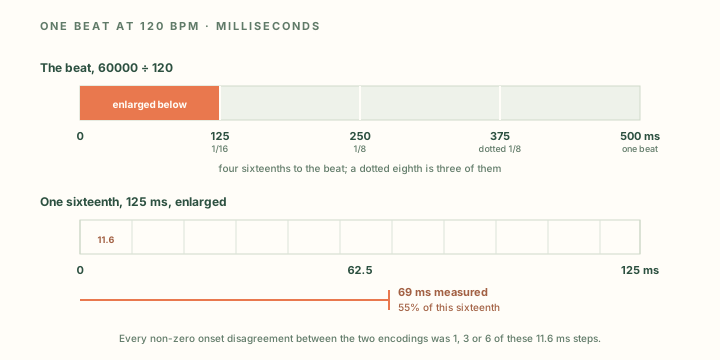
Put the two numbers side by side and the practical rule falls out. At 120 BPM a sixteenth is 125.00 ms and one step is 11.61 ms — 9.3% of it. The worst measured disagreement, 69 ms, is 55% of that sixteenth. So a delay time typed to two decimals is meaningful, because the delay is arithmetic; a note position read from a converted file is not, because the conversion rounds to its own grid. If you are aligning an echo to a note you found in an export, one step of slack is the floor, not zero.
Milliseconds back to BPM, and the one measurement worth taking
The inverse is the same constant: BPM = 60000 ÷ ms per beat. Measuring a whole bar is more accurate than measuring one beat, because the error is divided by four: a 4/4 bar at 120 BPM is 2000 ms, so BPM = 240000 ÷ bar ms. A bar that measures 1990 ms is 120.6 BPM; a bar that measures 2010 ms is 119.4 BPM. One beat measured as 499 or 501 ms gives 120.2 and 119.8 — the same tempo, a much wider spread.
| Measured | Formula | Result |
|---|---|---|
| One beat, 499 ms | 60000 ÷ 499 | 120.24 BPM |
| One beat, 501 ms | 60000 ÷ 501 | 119.76 BPM |
| One bar, 1990 ms | 240000 ÷ 1990 | 120.60 BPM |
| One bar, 2010 ms | 240000 ÷ 2010 | 119.40 BPM |
The step that makes this usable: tap or select four beats, read the elapsed milliseconds off the waveform, and divide 240000 by that number. Do not average four separate beat measurements — measure the span from the first beat to the fifth, once, so that only one rounding enters the calculation.
Questions about BPM and milliseconds
What is 120 BPM in milliseconds?
500 ms per beat. Divide again for shorter values: 250 ms for an eighth, 125 ms for a sixteenth, 62.5 ms for a thirty-second. Multiply for longer: 2000 ms for a 4/4 bar, 4000 ms for two bars.
How many milliseconds is a dotted eighth delay?
Three quarters of a beat: 375 ms at 120 BPM, 281.25 ms at 160 BPM, 562.50 ms at 80 BPM. A dotted eighth is the delay setting that makes repeats land on the off-beat sixteenth, which is why it is the default in so many presets.
Why does 128 BPM give awkward numbers?
Because 60000 does not divide by 128. A beat is 468.75 ms and a sixteenth is 117.1875 ms. At 120 the same values are 500 and 125 exactly, which is why 120 is easier to work with by hand — and why anyone who works at 128 in whole milliseconds accumulates a rounding error.
Can I get a tempo from a MIDI file?
Only if the file carries a tempo event. A conversion from audio often writes none, in which case the tempo you see in an editor is the program's default, not something the file stated. Measure the audio instead, or read the spacing of the onsets and divide.
Does 60 BPM mean one beat per second?
Yes — 60 BPM is exactly 1000 ms per beat, which makes it the easiest reference point in the whole table. Every other tempo is that second divided: 120 is half a second, 240 is a quarter second.
How precise should a delay time be?
Two decimals is enough, and more than enough. The number is exact arithmetic; the question is whether the thing you are aligning to is that exact. Onsets read from a converted file move in 11.6 ms steps, so aligning to one of those is only meaningful to about a tenth of that.