Can AI edit sheet music? Mechanically yes — and the verification stays human.
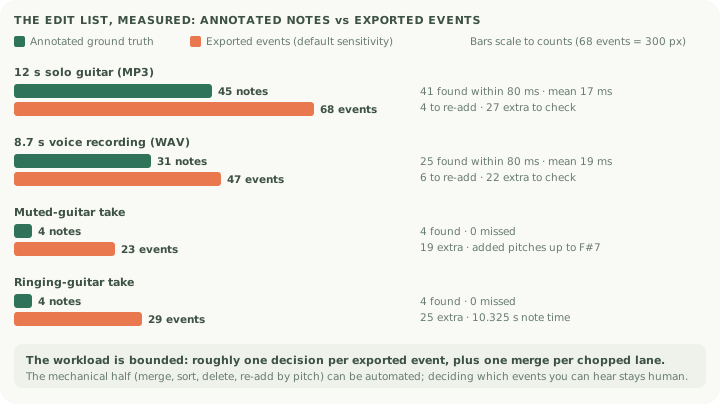
Yes — for the mechanical half, and the measured edit list shows exactly how much is mechanical. In the 12-second guitar passage: 27 extra events to check, 4 missing notes to re-add, 41 of 45 notes found within 80 ms. In the 9-second voice passage: 47 exported events against 31 annotated notes, with pitches reaching three octaves above the sung range. And in the 4.40-second mix: one held tone split into 7 events that merge to 1. AI can run the mechanical parts of that list — merge, sort, delete, re-add by pitch. What it cannot do is decide which of those 27 events you can hear in the recording, and that decision is the edit.
Convert a clip and count the editsThe edit list, measured
Every number below comes from this site's own test files, each downloadable with its export and — where one exists — its annotated ground truth. This is the work any transcription produces before it is a chart.
| Test file | Ground truth | Exported | The edit list it produces |
|---|---|---|---|
| 12 s solo guitar (MP3) | 45 notes, 15 pitches, A#2 to C5 | 68 events, 19 pitches, G#2 to C7 | 41 notes found within 80 ms; 4 missed to re-add; 27 extra events to check and delete |
| 8.7 s voice recording | 31 notes, 11 pitches, F#3 to E4 | 47 events, 15 pitches, F3 to E7 | 25 found within 80 ms; 6 missed; 22 extra events; octave-high artefacts up to E7 to delete |
| muted-guitar take | 4 notes, 3 pitches, A3 to E4 | 23 events, 13 pitches, A3 to F#7 | 4 found, 0 missed; 19 extra events; added pitches to F#7 to verify by ear |
| ringing-guitar take | 4 notes, 3 pitches, A3 to E4 | 29 events, 13 pitches, A3 to F#7 | 4 found, 0 missed; 25 extra events; 10.325 s of note time |
| 4.40 s multi-tone mix | one continuous low tone in the spectrum | 7 A3 events across the file | Merge to 1 held note: 7 events, 4.006 s, 91% of the file |
Read as a workload, it is bounded: roughly one edit decision per exported event, plus one merge per chopped lane. That is the honest size of "AI edits your sheet music" — the mechanical half can be automated; the by-ear half is yours.
Two synthetic takes, and the stacking the numbers reveal
The muted and ringing guitar takes exist to make one variable visible: the same four annotated notes (A3 to E4), played once into a synthetic guitar-like tone, muted and ringing. Both exports found all four annotated notes within 80 ms — and both added far more than they found.
| Take | Annotated | Exported | Extra events | Note time |
|---|---|---|---|---|
| Muted-guitar take | 4 notes, 2.480 s | 23 events, 13 pitches | 19 | 6.947 s |
| Ringing-guitar take | 4 notes, 4.550 s | 29 events, 13 pitches | 25 | 10.325 s |
The simultaneity counts show where the growth sits: in the muted export, 21 of the 23 events sound while at least three others sound (the export's busiest moments hold six events at once); in the ringing export, 25 of 29 do. The extra events are not random noise spread over time — they cluster into chords around the four real notes, which is exactly why deleting them is a by-ear job: a cluster of six simultaneous events can be one real note plus its decay, or a real chord, and only the recording tells you which.
The three judgements that stay with you
1. Which extra events are real. The guitar export carries 27 events the annotation does not have. Some are octave doublings of real notes, some are split tails, some are harmonics that sound fine in a mix. Each one is deleted or kept by playing the recording — no rule derived from the file settles it, because the file is the thing in question.
2. Which missing notes to add. Four annotated notes are absent from the guitar export, and they are missing because they sounded inside chords or below the detection threshold — the exact conditions a model cannot see. Adding them means reading the ground truth or knowing the song. An editor that invents them produces a plausible wrong chart.
3. Whether a merge is musical. The seven A3 events merge to one on a duration argument (4.006 s against one continuous 219.8 Hz tone). But the two pairs of onsets 0.163 s and 0.081 s apart could be played flourishes rather than split artefacts. On this synthetic file they are split artefacts; on your recording the answer comes from your ears.
An editing workflow that verifies as it goes
- Fix your expectation first. Before opening any editor, write down what you can hear: how many players, the bass line, the top note. That list is your ground truth, and it is what prevents a tooled-up wrong answer from surviving.
- Sort by pitch and deal lane by lane. The measured failures cluster by lane: the low lane splits (7 events, merge to 1), the high lanes gain octave artefacts (voice export up to E7), the middle lanes split inside chords.
- Merge with a stated threshold and a listen. Same pitch, gap under ~100 ms → candidate merge; play the window before you commit it. On the measured mix this is the whole bass fix.
- Delete by ear, not by rule. For each extra event: play the window with the event, play it without. Unhearable events go. That is the 27-event check on the guitar case.
- Re-add missing notes where the recording has them. If you can hear a note that is not in the export, it goes in — the four missed guitar notes are exactly this case, and no detector improvement measured here would have found them all.
- Compare against the answer key where you have one. The annotated files use an 80 ms match window with mean timing error of 15 to 19 ms on found notes — a fair criterion for "did the edit restore the note", not for "is the timing perfect".
So: yes, AI can edit sheet music — the merge, the sorting, the pitch-based re-adds are all mechanical and all automatable. The measurement above is the reminder that the automatable part is only half the job, and the half that stays human is the half that makes the chart true.
Questions about AI editing
Can AI fix a bad transcription?
It can fix the mechanical defects — merged chopped tones, sorted lanes, pitch-consistent re-adds — and the measured workload shows how much is mechanical: 27 events to check, 22 to remove, 7 to merge in the four test files here. It cannot verify what you can hear, and an unverified fix is just a different wrong chart.
Is editing faster than transcribing from scratch?
Yes, on this evidence. The export already carries most of the right pitches — the pitch collections in every measured test were correct or nearly so — so the job is correction, not creation. The correction is roughly one decision per event.
Can AI turn a PDF of sheet music into an editable file?
Nothing on this page was measured on scanned or exported PDFs, so no claim is made about them. Everything above concerns MIDI event data.
Can AI write the chord symbols a lead sheet needs?
It can propose them from the note events, and the proposal is checkable: play the chord and see if the symbol matches what sounds. The measured exports contain no chord data of their own — MIDI has no field for it.
Can I try it on my own track?
Yes. The converter on the home page runs in your browser with no account, processes the recording on your device, and exports a standard MIDI file that any editor opens for the steps above.