Sheet music for every instrument: one pass gives you a sketch, not parts.
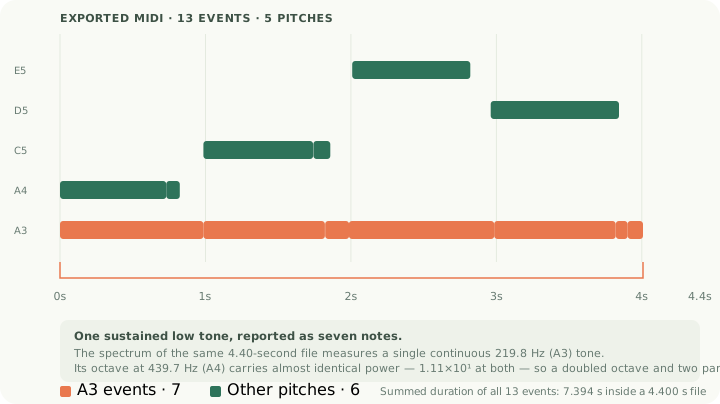
No — a single conversion of a full band recording will not hand you a part for each instrument. On a measured 4.40-second multi-tone file the converter found the right five pitches, but the structure came out wrong: one sustained low tone was reported as seven separate notes adding up to 91% of the file, and the thirteen exported events total 7.394 seconds of note time inside a 4.40-second recording. Pitches yes, parts no. The work that does produce parts is isolating one instrument at a time, and this page shows what that costs.
Convert a clip from your own trackWhat one pass produces on a mix
The test file is a controlled multi-tone mix, not a real band: several tones sounding together, 4.40 seconds, mono, 22,050 Hz. It is the site's own /examples/midilace-mix-test.wav. The exported MIDI and the spectral measurement of the same audio are both downloadable below, so every number here can be recounted.
| Measure | Result |
|---|---|
| Distinct pitches exported | 5 — A3, A4, C5, D5, E5 |
| Note events exported | 13 |
| Lowest pitch, separate events | 7, starting at 0.000, 0.986, 1.823, 1.986, 2.985, 3.821 and 3.902 s |
| Duration of those seven events, added up | 4.006 s — 91% of the 4.40-second input |
| Duration of all thirteen events, added up | 7.394 s — 1.68× the length of the recording |
| Measured spectrum, strongest tone | A3 at 219.8 Hz, one continuous tone; its octave A4 at 439.7 Hz carries near-identical power |
So the pitch list was right. Every one of the five exported pitches appears in the measured spectrum. What did not survive is the structure — how many instruments are playing, which note belongs to which, and when a tone starts and stops. That is the part you actually wanted.
The three things that break part structure
1. A sustained tone gets chopped. The low tone spans the whole file, yet it arrives as seven notes. The gaps between them are irregular — 0.986, 0.837, 0.163, 0.999, 0.836 and 0.081 seconds — so no single rule about "one note per beat" will rejoin them. This is the single most common reason a bass or organ part looks like a flurry of short notes instead of a held line.
2. An octave double is indistinguishable from a second instrument. A3 at 219.8 Hz and A4 at 439.7 Hz carry almost the same measured power, 1.11×10¹ on both. If your mix has a bass and a guitar an octave above it, the export contains both and gives you nothing to tell a doubled octave from two players. Sorting your MIDI by pitch and assuming the top line is a separate instrument is a guess, not a reading.
3. Inner voices go first. The hardest-measured case on this site is not the mix but a 12-second solo acoustic passage with every note annotated: 45 notes, 41 found within 80 ms, four missed, 27 extra events, mean timing error 15 to 17 ms. Two of those four misses happened while two or three notes rang at once; the other two were single notes that fell just below the detection threshold. A solo instrument still loses notes inside chords. A full band mix has that problem everywhere, not occasionally.
A full mix is harder than the solo case, not easier — more simultaneous sources, denser harmonics, and no single line for the model to lock onto. Treat the solo case as the ceiling on what a clean recording can do, not the floor.
The workflow that does give you parts
- Convert one instrument at a time. If you have stems or a multitrack, run each on its own. A single instrument is the case that measured well — 41 of 45 annotated notes — and each run gives you a part you can read as a part. Six solo passes beat one mix pass, even though it is six times the clicks.
- If you only have the mix, work in 10 to 20 second windows. Fewer simultaneous notes per window means fewer chopped tones and fewer duplicates, and you can check each window against the original before moving on.
- Rejoin the chopped low line first. Sort by pitch, find repeated notes at the same pitch, and merge the ones separated by less than about 100 milliseconds. On this test file that turns seven A3 events into roughly one held note, and it is the difference between a bass part and noise.
- Deal with the octave layer by listening, not by pitch. Play the original, then play the export with the suspected duplicate line muted. If nothing disappears from the recording, the line was an artefact.
- Write the inner voices yourself. Where the recording has chords, expect to supply the middle notes by hand. On the measured case, three notes in twelve seconds was the whole edit.
- Keep the original beside the export. Any event you cannot hear in the recording is safe to delete, and any note you can hear but cannot find in the export is one you have to add.
What you get at the end of that is a sketch you have corrected into something playable — which is a different claim from "sheet music for every instrument", and it is the honest one.
Questions about full band recordings
Can any tool transcribe every instrument in a song at once?
Not from a single mixed recording, and the measurement above shows why: the pitch collection survives, the part structure does not. If a tool shows you per-instrument output, check what it was given — separated stems produce a different result from one mixed file — and treat the output as an editable sketch until you have compared it against the recording yourself.
How long should each clip be?
Ten to twenty seconds. Long enough to contain a phrase, short enough that you can check every note by ear.
Does a better recording help?
It helps the pitch detection, which was already correct here. It does not fix the part structure. Separating the instruments before conversion is what fixes that.
What about drums?
A drum kit is the hardest case, because a single stroke contains a broadband noise burst rather than a clear pitch. Nothing on this page was measured on drums, so no claim is made about them.
Can I try it on my own track?
Yes. The converter on the home page runs in your browser with no account, and the recording is processed on your device rather than uploaded to a server.