How to read a time signature: two numbers, and then the evidence.
The top number is how many beats go in a bar; the bottom number is which note value counts as one beat. 4/4 means four quarter-note beats; 6/8 means six eighth-note beats, heard as two groups of three. Tempo turns that into seconds: at 120 BPM a quarter lasts 0.500 s, so a 4/4 bar is 2.000 s. A file that declares no signature has to be read from its onsets instead — and on the site's export the 11 onsets split 6 and 5 across two 4/4 bars, with both empty beats landing on beat 3. Read as 3/4 the same onsets bunch 3, 6 and 2, and one bar takes six of them. The even split is the evidence, and it is the only evidence the file offers.
Convert a clip and count its onsetsWhat each half of the signature tells you
The numerator is a count and the denominator is a unit. That is the whole of the notation, and every mistake in reading it comes from treating the denominator as a fraction of a bar rather than as the name of the beat. The table below reads four signatures the same way, including the two that share a bar length and still feel different.
| Signature | Top number says | Bottom number says | What you tap |
|---|---|---|---|
| 4/4 | 4 beats per bar | quarter note is the beat | four even taps, 0.500 s apart |
| 3/4 | 3 beats per bar | quarter note is the beat | three taps, the first one strong |
| 2/2 (cut time) | 2 beats per bar | half note is the beat | two taps, 1.000 s apart — half as many as 4/4 |
| 6/8 | 6 beats per bar | eighth note is the beat | six taps, but felt as two groups of three |
6/8 is the one that catches people. Six eighth notes and three quarter notes fill the same 1.500 s at 120 BPM, and they are not interchangeable: 3/4 groups the bar in twos and 6/8 groups it in threes. If you tap along to a 6/8 tune and land on two accents per bar, you are hearing the grouping, not miscounting the beats.
Nothing — so the onsets become the evidence
A Standard MIDI File can state its meter in a time-signature meta event (0xFF 0x58). The export of this site's 4.40-second test mix has no such event: its only meta events are an empty track name and end-of-track. The format has no bar-line event either, so nothing in the file marks where a bar begins. Any meter you see in a notation program came from the program's default, not from the file.
That leaves the onsets. They are measurements, and a meter that groups them evenly is better supported than one that does not. The test is simple: impose each candidate signature, count onsets per bar, and look at the spread.
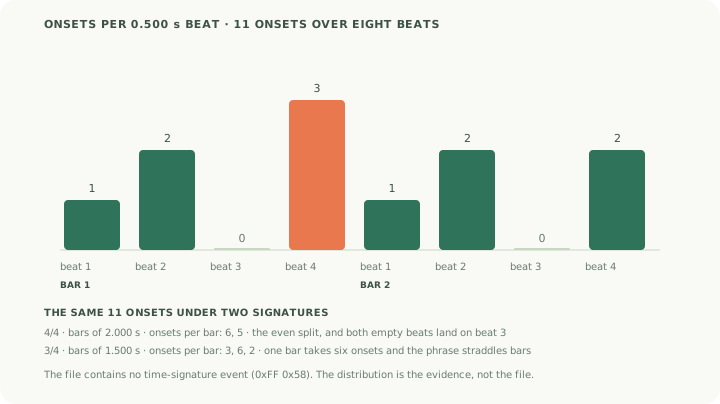
The same onsets under three signatures
Nothing changes in the audio between the rows below. The bar lines move, and the distribution of the same 11 onsets across bars changes with them — which is exactly the signal you want, because a meter is a claim about where the bar starts.
| Signature | Bar length | Onsets per bar | What breaks |
|---|---|---|---|
| 4/4 | 2.000 s | 6, 5 | nothing — the split is near even and both empty beats land on beat 3 |
| 3/4 | 1.500 s | 3, 6, 2 | one bar takes six onsets while another takes two, and the 1.823/1.986 s pair straddles a bar line |
| 6/8 | 1.500 s | 3, 6, 2 | same spans as 3/4, but the grouping in threes has no support: the onsets do not fall in triplets |
4/4 wins on two counts: the split is 6 and 5 rather than 3 and 6, and the two empty beats fall in the same position in both bars. That second point is the stronger one. A meter that puts the silence in the same place twice is a meter the music is agreeing with; a meter that scatters the silence is one you imposed.
Reading a signature off a recording
- Tap the pulse first, without counting. The pulse is what you would nod to; the signature is a grouping of that pulse. On this file the pulse is 0.500 s, which at 120 BPM is a quarter note.
- Count until something repeats. Count taps and stop where the pattern of accents comes back. Four taps repeating means a four-beat bar; three means three.
- Check the denominator against the note values. If the melody moves in eighths and the bar holds six of them, the signature is 6/8, not 3/4 — same length, different subdivision.
- Test the alternative and see what breaks. Impose the runner-up and count onsets per bar. If one bar swallows half the notes and another is nearly empty, the alternative is wrong. That is the test in the table above.
- Say which part is inference. The pulse is measurable; the grouping is a judgement. On a file with no time-signature event, write down that you chose the meter rather than read it.
Questions about reading time signatures
What does the bottom number mean, exactly?
It names the note value that gets one beat: 4 means a quarter note, 8 means an eighth, 2 means a half. It is not a fraction of the bar and it does not change the tempo — it changes which note the tempo counts.
Why is 6/8 not the same as 3/4?
Because the grouping differs. Three quarter notes and six eighth notes fill the same span, but 3/4 is felt in twos against a three-beat frame and 6/8 is felt in threes. The accents land in different places, which is audible even when the duration is identical.
How do I read a signature when there is none in the file?
From the onsets. Impose each candidate, count onsets per bar, and prefer the one that spreads them evenly and puts the empty beats in consistent positions. On the measured file that is 4/4, with a 6/5 split.
Does a pickup bar break the count?
It can, and it is worth checking before you trust the bar lines. A pickup means the first bar is short, so the first bar's onset count will look wrong while every later bar looks right. The measured file starts on a downbeat at 0.000 s, so there is no pickup to account for.
What about cut time?
2/2 has two beats per bar and a half note gets the beat, so at 120 BPM the taps are 1.000 s apart and a bar is 2.000 s — the same length as 4/4 with half as many beats. The music sounds faster because you are counting bigger units, not because the tempo changed.