Piano solo, piano/vocal, lead sheet: how much is written, how much is symbolized.
The three formats differ in what is written out and what is left as a symbol. A piano solo writes every note of the arrangement; a piano/vocal chart writes a piano reduction plus the vocal line; a lead sheet writes the melody and chord symbols and leaves the rest to the player. Measured on this site's exports: the 5-second piano test produced 30 events across 8–9 pitches — piano-solo material — and the 9-second voice test produced 47 events where the annotated line has 31 notes. None of the exports contains a single chord symbol, because MIDI stores note events, not harmony labels.
Convert a clip and count the eventsThe three formats, side by side
The formats are answers to one question: what does this player need to see? The figure below sets them against what this site's own test exports actually contain — a 5.0-second piano recording and a 8.7-second voice recording, both downloadable with their exports and, where one exists, its annotated answer key.
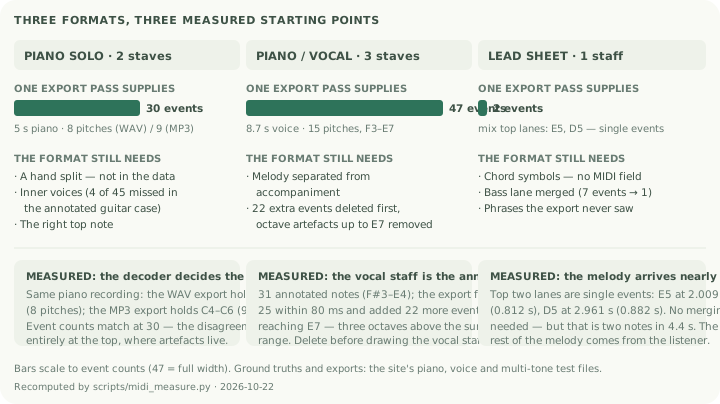
| Format | What is written out | What is symbolized | Measured material on this site |
|---|---|---|---|
| Piano solo | Both hands, every note of the arrangement | Nothing much — that is the point | Piano test export: 30 events, 8 distinct pitches from WAV (9 from MP3), range C4 to G5 / C4 to C6 |
| Piano/vocal | Piano reduction plus the sung melody on its own staff | Accompaniment trimmed to fit one staff pair | Voice test: 31 annotated notes (F#3–E4) against a 47-event export reaching E7 — 25 notes found within 80 ms, 22 extra events |
| Lead sheet | The melody only | Chord symbols; bass line often sketched | Mix export top lanes: single events on E5 and D5 — a two-note melody fragment |
One measured detail worth keeping: the same piano recording converted from WAV and from MP3 produced exports that disagree at the top — the WAV export reaches C4 to G5 (8 pitches) while the MP3 export reaches C4 to C6 (9 pitches). A piano solo chart is precisely the format where that disagreement shows up as a wrong top note.
Why an export is never automatically one of the three
A piano solo needs two staves read as two hands. The measured piano export is 30 events on 8–9 pitches — but which events are the left hand is not in the data. A split around middle C is a starting convention, and on a real arrangement it is wrong as often as it is right.
A piano/vocal chart needs the melody separated from the accompaniment. The voice test's annotated line is 31 notes across 11 pitches (F#3 to E4); its export is 47 events across 15 pitches reaching up to E7 (MIDI 100). Matching the two within 80 ms finds 25 of the 31 annotated notes and leaves 22 export events unmatched. The vocal staff of a piano/vocal chart is the annotated line, not the export — those 22 events are the thing you delete before that staff can be drawn.
A lead sheet needs chord symbols the data cannot hold. MIDI has no chord field. The mix export's melody lanes (E5 and D5, one event each, 0.812 s and 0.882 s) could sit on a lead sheet's melody staff today; the symbols above them are added by ear, by the player, from the recording. Any tool claiming chord symbols from a single export is inferring them from note patterns, and that inference is checkable — listen to the chord and see if the symbol matches.
Which format to hand your player
- Pianist playing alone: piano solo, if you can supply the inner voices. The measured piano export is a complete event list but a fragment of an arrangement — the missing inner notes on this site's annotated guitar case were four of 45, and chords lose notes first.
- Singer with accompanist: piano/vocal, built from two passes. Convert the accompaniment alone and the vocal line alone where you can. The voice test shows why: matching the full-mix export against the annotation leaves 22 extra events, and a vocal staff with those on it is worse than no staff.
- Band reading on the stand: lead sheet, and expect to write the symbols. The melody lanes come out of one pass nearly clean — single events on the top two lanes of the measured mix — and the chord symbols are fifteen minutes of listening per tune.
- Bass player: ask for the bass line, not a format. The measured mix's low lane is seven chopped events totalling 4.006 seconds; merged it is one held note covering 91% of the file, which is what the bass player can read.
- Whatever the format: label what was measured and what was inferred. The downloadable files on this site exist so a player can check every note against the recording.
Questions about chart formats
What is the actual difference between a lead sheet and a piano/vocal chart?
The lead sheet is melody plus chord symbols — one staff, mostly. A piano/vocal chart adds a written piano reduction and puts the melody on its own staff — two staves of notes. The lead sheet asks more of the player; the piano/vocal chart asks more of the arranger.
Can a converter produce a lead sheet?
It can produce the melody lane, which is most of one. Measured on the site's mix test, the top two lanes are single events on E5 and D5 — readable as a melody fragment. The chord symbols are not in any MIDI export, so those come from a listener either way.
Why did the WAV and MP3 piano exports disagree?
Different decoders, same recording: the WAV export holds 8 distinct pitches topping out at G5; the MP3 export holds 9, topping out at C6. The event counts match at 30 — the difference is entirely at the top of the range, where artefacts live.
Which format is easiest to read at a gig?
The lead sheet, for players who comp — and the hardest to fake, because the symbols must be right. Piano/vocal is the most self-contained for a singer-pianist duo. A piano solo chart for a tune with vocals is usually the wrong document.
Can I try it on my own track?
Yes. The converter on the home page runs in your browser with no account, processes the recording on your device, and exports standard MIDI that any notation program opens.