Transcribing a jazz combo recording: expect to edit, not to read.
Jazz attacks transcription from three sides at once, and each side hits a measured weak spot. On this site's test files: a sustained bass tone arrives as seven separate notes with gaps as short as 0.081 seconds; two 5.4-second guitar takes with only four real notes each produced 23 and 29 exported events across 13 distinct pitches, reaching F#7 (MIDI 102) — 38 semitones above the highest annotated note; and an octave pair in the mix carried near-identical power, so a bass and a guitar an octave up are indistinguishable in the data. Plan on a sketch plus corrections.
Convert a clip from your own recordingWhat jazz looks like to the converter
A jazz combo is a walking bass, comping chords behind the solo, and a lead line — several sources, held tones and clustered chords in one recording. That is the same shape as this site's synthetic tests, so they measure the failure modes directly. All four files below are downloadable: two 5.4-second guitar-like takes, each with only four annotated notes, and their exports.
| Measure | Muted take | Ringing take |
|---|---|---|
| Annotated notes (ground truth) | 4 | 4 |
| Note events exported | 23 | 29 |
| Distinct pitches exported | 13 | 13 |
| Pitch range exported | A3 to F#7 (57–102) | A3 to F#7 (57–102) |
| Ground-truth pitch range | A3 to E4 (57–64) | A3 to E4 (57–64) |
| Moments with 3 or more events at once | 4 | 4 |
| Moments with 5 events at once | 2 | 1 |
Four real notes became 23 and 29 events. The events are not random — most land at the right pitches — but the count is roughly six to seven times the truth, and the added pitches reach more than three octaves above anything played. A jazz recording adds walking bass and comping on top of that, so the multiplier grows, not shrinks.
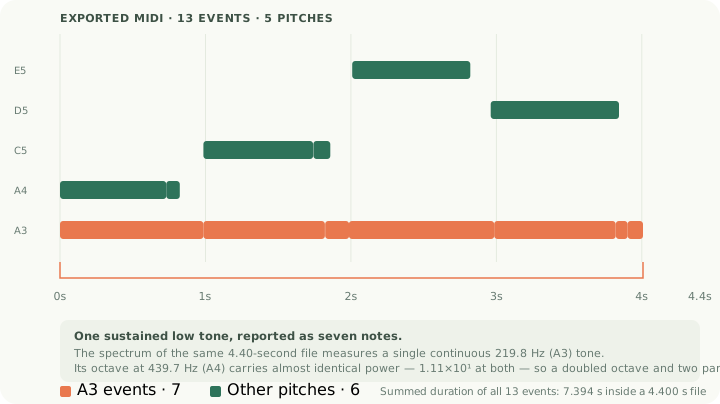
The three jazz ingredients that break the export
1. A walking bass is a held line, and held lines get chopped. In the measured mix, one continuous low tone — 219.8 Hz in the spectrum — arrived as seven notes starting at 0.000, 0.986, 1.823, 1.986, 2.985, 3.821 and 3.902 s, totalling 4.006 seconds of a 4.40-second file. The gaps are irregular: 0.986, 0.837, 0.163, 0.999, 0.836, 0.081 seconds. No "one note per beat" rule rejoins that, so the bass staff fills with short fragments that do not match the feel of the walk.
2. Comping is exactly the pattern that splits. The two shortest gaps in the measurement — 0.163 s and 0.081 s — are chord tones of one gesture arriving closer together than a sixteenth note at a slow ballad tempo. That is comping. In the two guitar takes, moments with three or more events sounding at once appear four times in 5.4 seconds, and the export reaches five simultaneous events twice. Clustered chord tones are where the event count explodes.
3. Doubles are invisible in the data. The mix's A3 at 219.8 Hz and A4 at 439.7 Hz carry almost identical measured power, 1.11×10¹ on both. A bass with a guitar an octave above, or a comping hand doubling the bass an octave up, lands as two pitches with nothing in the MIDI saying "same instrument". Sorting the export by pitch and calling the top line a separate player is a guess.
No claim is made here about cymbals, hi-hats or brushes. A crash is a broadband noise burst rather than a clear pitch, and nothing on this page was measured on one.
A jazz workflow that survives the numbers above
- Work one chorus — or one phrase — at a time. Convert 10 to 20 second windows. Each window's chord is knowable by ear, so every event can be checked against the recording instead of trusted.
- Fix the bass lane before anything else. Sort by pitch, find the lowest lane, merge repeated notes at the same pitch separated by less than about 100 milliseconds. On the measured mix that turns seven A3 events into one held note covering 91% of the file — a bass part you can read.
- Treat every 3-plus-event moment as comping, not as truth. Where the export shows three or more onsets at once, play the window and decide by ear which tones are really sounding. In the measured takes, that decision removed most of the 19 to 25 extra events.
- Check octave doubles by muting. For each suspected doubled line, mute it in the export, play the original, and keep the line only if a sound disappears. Equal measured power on the octave pair means the data will not settle it.
- Keep an 80-millisecond tolerance when comparing to the record. The annotated guitar case on this site uses 80 ms as its match window, with mean timing error of 15 to 17 ms on the notes it did find. If an event lands within that window of the note you can hear, count it found and move on.
- Write the solo's inner notes by hand where chords ring. Even a solo acoustic passage — the easiest case measured — lost four annotated notes inside chords out of 45. A combo under a solo loses more, and the missing ones have to be supplied by you.
What comes out of that is a sketch you have corrected phrase by phrase. It is slower than reading a finished chart, and it is the only version of the job the measurements support.
Questions about jazz transcription
Can any tool transcribe a jazz combo accurately?
Not from a single mixed pass, on this evidence. The pitch collection survives and the event count does not: four annotated notes became 23 and 29 events in the measured takes, and a held bass tone arrived as seven notes. Treat the export as a draft to correct against the recording.
Why did the export reach F#7 when the player stayed below E4?
The extra high events are harmonic and decay artefacts — the export hears energy at octave and near-octave frequencies and writes it as notes. On the two measured takes the top exported pitch was 102 (F#7) against a ground-truth maximum of 64 (E4). They are checkable one by one: play the window and delete what you cannot hear.
Does a cleaner recording help?
It helps the pitch estimates, which were mostly right here. It does not fix the splitting, the comping bursts or the octave doubles, because those come from several sources sharing one file.
What about a solo jazz piano recording?
Closer to the measured solo cases — the annotated guitar passage, where 41 of 45 notes were found within 80 ms — but still with chords, so still expect missing inner notes and extra events to check.
Can I try it on my own track?
Yes. The converter on the home page runs in your browser with no account, and the recording is processed on your device rather than uploaded.