Transcribing a band demo: the export gives you a pitch sketch, not parts.
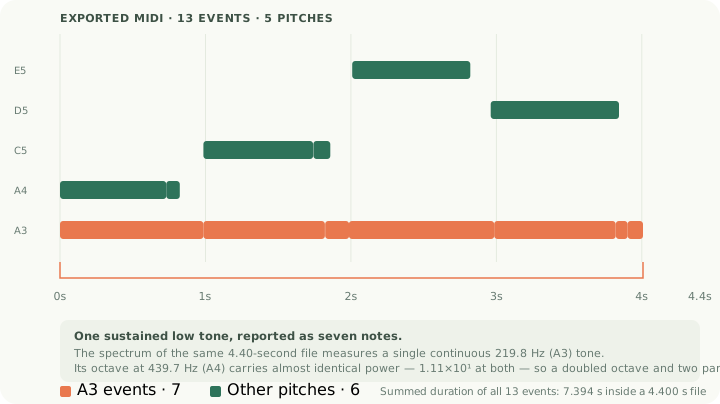
A single pass over your demo will not hand you a part per player. On a measured 4.40-second multi-tone file the converter found the right five pitches, but the note events came out at thirteen, totalling 7.394 seconds of note time inside a 4.40-second recording — 1.68× the length of the source — and the one sustained low tone was split into seven separate notes adding up to 91% of the file. So: pitches yes, parts no. The parts come from a per-instrument workflow, and this page is that workflow with the measured numbers attached.
Convert a clip from your own demoWhat one pass over a demo recording produces
The test file is a controlled multi-tone mix, not a real band: several tones sounding together, 4.40 seconds, mono, 22,050 Hz. It is the site's own /examples/midilace-mix-test.wav, and both the input and the exported MIDI are downloadable below, so every number here can be recounted. A demo recording is the same shape of input — several instruments in one file — so the failure modes are the ones to plan for.
| Measure | Result |
|---|---|
| Distinct pitches exported | 5 — A3, A4, C5, D5, E5 |
| Note events exported | 13 |
| Lowest pitch, separate events | 7, starting at 0.000, 0.986, 1.823, 1.986, 2.985, 3.821 and 3.902 s |
| Duration of those seven events, added up | 4.006 s — 91% of the 4.40-second input |
| Duration of all thirteen events, added up | 7.394 s — 1.68× the length of the recording |
| Measured spectrum, strongest tone | A3 at 219.8 Hz, one continuous tone; its octave A4 at 439.7 Hz carries near-identical power |
Read the table as a parts list and you can see the gap immediately. The pitch collection is right — all five exported pitches appear in the measured spectrum. What is missing is the answer to the question you actually have: which of these five lanes is the bass, which is the guitar, and who plays the two events on C5. The export has no field for that. It has pitch, onset and duration, and nothing about players.
The three corrections your demo will need
1. The bass line arrives chopped. The low tone is continuous in the spectrum but arrives as seven notes. The gaps between them are irregular — 0.986, 0.837, 0.163, 0.999, 0.836 and 0.081 seconds — so no single "one note per beat" rule will rejoin them. On a real demo this is the bass part showing up as a flurry of short notes, and it is the first thing to fix: sort the export by pitch, merge repeated notes at the same pitch separated by less than about 100 milliseconds, and seven events collapse back toward one held line.
2. An octave double reads as a second player. A3 at 219.8 Hz and A4 at 439.7 Hz carry almost the same measured power, 1.11×10¹ on both. A bass and a guitar an octave above it will both be in the export with nothing in the data telling you it is one doubling rather than two parts. Mute the suspected duplicate in the export, play it beside the demo, and keep the line only if something actually disappears from the recording.
3. Inner voices are yours to supply. The hardest-measured case on this site is a 12-second solo acoustic passage with every note annotated: 45 notes, 41 found within 80 ms, four missed, 27 extra events, mean timing error 15 to 17 ms. That is a solo instrument — the ceiling on what a clean recording can do. A demo has more simultaneous sources than that, not fewer, so the four-missed-notes problem appears on every chord, not occasionally. Plan on writing the middle voices by ear against the demo you already know.
One advantage a demo has over a mystery recording: you were there. You know how many players there are and roughly what each one plays, so every candidate line in the export can be checked against memory instead of guessed.
The demo workflow that does produce parts
- Convert in 10 to 20 second windows, not the whole song. Fewer simultaneous notes per window means fewer chopped tones and fewer duplicates, and each window can be checked against the demo before you move on. A three-minute demo is nine to eighteen windows — tedious, but each one is verifiable.
- If the demo was tracked with stems or a multitrack, use them instead. One solo pass per instrument is the case that measured well — 41 of 45 annotated notes in the 12-second guitar passage — and each pass gives you a part you can read as a part. Six solo passes beat one mix pass even though it is six times the clicks.
- Rejoin the low line first, then the top. Sort by pitch. On the measured file the bass lane is seven events spanning 4.006 seconds of a 4.40-second file, which after merging is one held note covering 91% of the recording. The top lanes are smaller problems: E5 is one event of 0.812 s, D5 one of 0.882 s.
- Assign lanes to players by listening, not by pitch order. The export's five lanes are just five pitches. Which lane is the rhythm guitar and which is the keyboard is a question the recording answers and the MIDI does not.
- Delete what you cannot hear and add what you can. Any event you cannot find in the demo is safe to remove — on the measured guitar case that was 27 events to check. Any note you can hear but cannot find in the export is one you have to write in; on that same case it was four notes.
- Hand each player their lane as MIDI, with the sketch attached. What you deliver at the end is a corrected sketch: five lanes, merged low line, missing inner voices added by hand. That is a different claim from "parts per instrument", and it is the honest one.
Budget the work per player, not per song. The measured edit load on this site's files — seven chopped events to merge, 27 extras to check, four missing notes to add — is the normal size of the job for a four-to-twelve second window, and it scales with how dense the demo is.
Questions about transcribing demos
Can I get MIDI for each player separately?
Not from one mixed pass. The measured export has five pitch lanes and no player information. Per-player MIDI comes from per-player passes — stems if you have them, sectioned windows if you do not — plus the merging and checking described above.
How long should each clip be?
Ten to twenty seconds. Long enough to contain a phrase, short enough that you can check every note by ear against the demo.
The export shows more note time than the recording has. Is that a bug?
It is what overlapping events look like. Measured here: thirteen events totalling 7.394 seconds inside a 4.40-second file, which is possible only because notes overlap in time. The same effect appears as multiple notes sounding at the same instant, and it is one of the signals that the structure needs editing.
Should I convert the click track too?
Nothing on this page was measured on a click or drum machine, so no claim is made about them. Work on the musical windows and keep the click out of the clip if you can.
Can I try it on my own demo?
Yes. The converter on the home page runs in your browser with no account, the recording is processed on your device rather than uploaded, and the exported MIDI opens in any DAW for the merging and adding steps above.