Transpose calculator: add the semitones, read the new note.
To transpose, add the same number of semitones to every note number in the file. C4 is 60, so +4 is 64 and reads back as E4; +12 is one octave, which is why the names repeat and only the octave number changes. The ceiling is what most calculators skip: on the measured export below, spanning C4 to C6 (60–84), the top note has 24 semitones of headroom before it leaves an 88-key piano and 43 before it leaves the file format — the keyboard gives out 19 semitones first.
E4 — note number 64, inside the 88-key piano.
C to G is +7 semitones up or −5 down; either one lands on the same key.
Why one number is the whole operation
Note numbers count semitones from a fixed origin: 0 is C−1, 60 is C4, 69 is A4. Because the scale is evenly spaced, transposition is not a lookup — it is addition. A shift of +4 adds 4 to every note-on and every note-off in the file, and the result is a correct transposition with no further rules applied.
The rule that surprises people is what doesn't change. Durations are stored in ticks, not in pitches, so a transposed file has the same rhythm, the same tempo, the same note lengths. Only the pitch byte moves. If a file sounds slower after transposing, something else touched the tempo — transposition itself cannot.
| Interval | Semitones | Example from C4 (60) |
|---|---|---|
| Minor second | 1 | 61 — C♯4 |
| Major third | 4 | 64 — E4 |
| Perfect fifth | 7 | 67 — G4 |
| Octave | 12 | 72 — C5 |
| Two octaves | 24 | 84 — C6 |
Eight shifts of the same file, and the one that falls off the keyboard
The site's own piano export holds 30 note events across 9 distinct pitches, C4 to C6 — note numbers 60 to 84. That span is exactly 24 semitones, so every shift below moves the block rigidly: the width never changes, only where it sits. This is why the limit is decided by a single note, the top one, and not by the piece as a whole.
| Shift | Note numbers | Reads as | On an 88-key piano? |
|---|---|---|---|
| 0 | 60–84 | C4–C6 | yes |
| +2 | 62–86 | D4–D6 | yes |
| +5 | 65–89 | F4–F6 | yes |
| +12 | 72–96 | C5–C7 | yes |
| +24 | 84–108 | C6–C8 | yes — the top note lands on the last key |
| +25 | 85–109 | C♯6–C♯8 | no — 109 is one step above C8 |
| −39 | 21–45 | A0–A2 | yes — the bottom note lands on the first key |
| −40 | 20–44 | G♯0–G♯2 | no — 20 is one step below A0 |
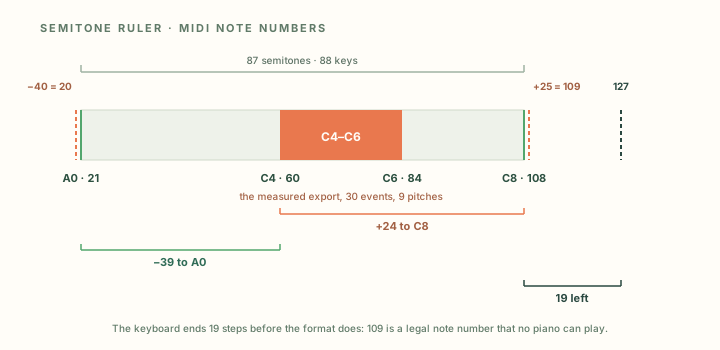
The keyboard ends at 108. The file format ends at 127.
Those are not the same wall, and the gap is worth knowing before you pick a shift. The 88-key piano tops out at C8, note number 108; the MIDI note number itself runs to 127. From this export's top note of 84, that is 24 semitones to the last key and 43 to the last legal number — the keyboard runs out 19 semitones before the format does.
In between sits a range that is legal but unplayable: 109 to 127 exists in the file, will export, will open in an editor, and will make no sound on a piano. A calculator that only checks the format's own bounds will happily hand you a transposition that no instrument can play. That is the case this export reaches at +25 — the arithmetic is fine, the piano is not.
The same asymmetry exists at the bottom. Below A0 the numbers keep going down to 0, so 39 semitones down is the last playable shift and 40 is the first silent one.
Transposing instruments: the shift is already built into the part
Most transposition questions come from players rather than from files. A transposing instrument is written at one pitch and sounds at another, so the shift between the page and the air is fixed by the instrument. To move a written part into concert pitch, subtract the interval in the last column.
| Instrument | Written C4 sounds | Shift to concert pitch |
|---|---|---|
| B♭ trumpet | B♭3 | −2 semitones (major second down) |
| B♭ clarinet | B♭3 | −2 semitones |
| F horn | F3 | −7 semitones (perfect fifth down) |
| E♭ alto saxophone | E♭3 | −9 semitones (major sixth down) |
| Guitar | C3 | −12 semitones (one octave down) |
This is why a converter's output can look "wrong" to a player reading the original part. If a B♭ trumpet plays a written C, the audio contains a B♭, and the export says 58 — not 60. The file is not mistaken; it is reporting concert pitch, which is what sounded. To read the part back, add 2.
Three things the arithmetic cannot do for you
- It cannot choose the spelling. 60 shifted by 1 is 61, and 61 is C♯4 or D♭4 — the same key on the piano, two names on the page. Which one is right depends on the key you are moving into, not on the number. Pitch class 6 is written F♯ in G major and G♭ in D♭ major; both are the same key, and both are correct in their own key. A file carries no target key, so the arithmetic can hand you the number but never the spelling.
- It cannot fix a bad note — it carries it. The site's vocal export reaches note 100 (E7), while the hand-annotated ground truth for the same take stops at 64 (E4): a spurious octave, 36 semitones above anything that was sung. Transpose that file up 28 semitones and the phantom note lands on 128, which is not a representable note number, while the real melody's top lands on 92 (G♯6) and would have been fine. The limit was set by an error, not by the music. Correct octave errors before transposing, never after.
- It cannot make a part playable. Shifting a part into a singer's key moves every note by the same amount, so a melody that spans 24 semitones still spans 24 semitones afterwards. If the range does not fit, transposition moves the problem; it does not shrink it. Changing the span means rewriting notes, which is a different job.
Questions about transposing
How many semitones is a major third?
Four. Minor third 3, perfect fourth 5, perfect fifth 7, major sixth 9, octave 12. These are the numbers you add; every interval question is one of them plus or minus an octave.
Why does +12 sound the same but read differently?
Because twelve semitones is exactly one octave, and the note names repeat every twelve steps. A view that lists only pitch classes — A, C, D, E and so on — cannot tell a shift of 0 from a shift of 12 or 24. Note numbers can, which is why the octave number matters when you transpose a part rather than a chord.
Does transposing change the tempo?
No. Tempo is stored separately from pitch, and durations are counted in ticks. A transposition rewrites note numbers and leaves timing untouched, so a file that speeds up or slows down afterwards was changed by something else.
How do I transpose for a guitar capo?
A capo on fret n raises the sounding pitch by n semitones while you keep using the same shapes. To keep the sounding key where it was, transpose the written part down n: capo 2 with shapes in G sounds A, so a part written in A becomes G at −2.
Can I transpose a file that has no key signature?
Yes — transposition does not need a key. It needs note numbers, and every note event carries one. The key only decides how the result should be spelled on a staff, which is the step after the arithmetic.
What is the highest note I can transpose to?
In the file format, 127. On a piano, 108. On the measured export above, that is 43 or 24 semitones up from its top note respectively. Check the instrument, not just the format, before you commit to a shift.