Guitar to MIDI, and the three things you will have to fix.
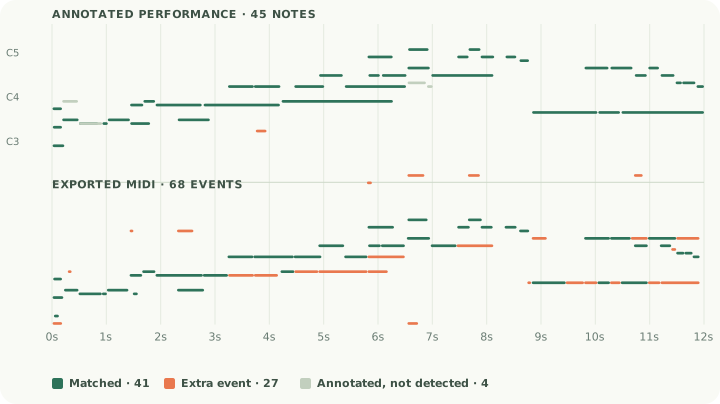
Yes, a guitar recording converts to MIDI, and single-note lines convert well. On a measured 12-second acoustic passage, 41 of 45 annotated notes were found with a mean timing error of 15 to 17 ms. What you get on top of that is the real work: 27 extra events, eight of them exactly an octave from a real note, notes missed inside chords, and held notes that end early. This page is about recognising those errors quickly and fixing them, rather than about claiming a clean result.
Convert a guitar trackWhere the numbers come from
Testing a converter on your own file proves nothing, because nobody knows what the correct notes were. So the case here uses GuitarSet, a research dataset of acoustic guitar performances where every note is annotated by string and fret, released under CC BY 4.0. The excerpt is the first 12 seconds of 00_BN1-129-Eb_solo_mic.wav from player 00: 45 annotated notes across 15 pitches, played mostly as single lines with a few two- and three-note chords.
A note counts as found when the exported pitch matches and the onset lands within 80 ms. That rule is stated so you can disagree with it and recount from the published event list.
| Measure | Result |
|---|---|
| Annotated notes in the window | 45 |
| Annotated notes found within 80 ms | 41 |
| Extra events with no annotation | 27 |
| Mean / worst onset error | 15–17 ms / 72 ms |
| Mean note length, exported vs annotated | 0.34 s vs 0.48 s |
The full event-by-event audit, the WAV-versus-MP3 comparison and the licence details are on the test files page. Everything below follows from those files.
What actually goes wrong
1. Notes vanish, most often inside chords. Two of the four missed notes sound while two or three strings ring at once; the other two are single notes that fell just below the default confidence threshold. If you need a chord part transcribed, expect to write the inner voices yourself.
2. Harmonics appear as a second part. Of the 27 extra events, eight sit exactly one octave from an annotated pitch — five above it, three below — and most of the rest land a fourth or a fifth below a real note sounding at the same moment. A plucked steel string produces strong energy at the octave and the twelfth; a pitch model fed a mixed microphone signal cannot tell a harmonic from a second string.
3. Held notes come out short. Exported notes averaged 0.34 s against 0.48 s annotated, because a decaying string falls below the detection threshold long before the player releases it. This one is harmless if you fix it, and obvious if you do not: playback sounds clipped and mechanical.
The setting is a trade-off, not a fix. More notes recovers one more real note and all of the clutter — 113 events, 71 of them extra. Fewer, cleaner goes the other way: 55 events, 16 extra, but only 39 of the 45 annotated notes survive.
A short routine that makes the MIDI usable
- Delete the octave layer first. Sort notes by pitch and look for a line exactly 12 semitones above the melody. Removing it is usually the single biggest improvement, and it is fast because the duplicates line up with real onsets.
- Stretch before you quantise. Extend short notes to their written value first. Quantising a dashed line of 0.26-second fragments locks the fragments to the grid and makes the part sound worse.
- Check the chord moments. Where the guitar strums, listen for a missing middle voice and add it by hand. Three notes in 12 seconds is a small edit, not a rewrite.
- Convert a phrase at a time. Use the section controls to work in 10 to 20 second windows. Fewer overlapping rings per window means fewer duplicates, and you can check each window by ear before moving on.
- Record with the other strings muted. Clean left-hand damping and palm muting remove most of the ring that produces the octave duplicates in the first place.
- Keep the original beside the MIDI. Play both back to back. Any extra event you cannot hear in the recording is safe to delete.
Distorted electric guitar, twelve-string and heavily reverbed takes behave worse than this case, because the harmonic content is denser and the attack is smeared. Treat the note list as a sketch there, not a transcription.
Does the MP3 hurt the result?
Barely, here. The same 12 seconds encoded at 128 kbps produced exactly the same result: 68 events, 41 matched, 27 extra, the same onset errors. At the earlier, more sensitive setting the MP3 did differ by one event — a spurious A5 on the synthetic three-note test — so a lossy encode can add errors, but it does so at the margins. The model's handling of polyphony and harmonics dominates both. Use the best source you have, then spend your effort on the arrangement and on editing.
Questions about guitar to MIDI
Can I convert a guitar recording to MIDI for free?
Yes. The converter on the home page runs in your browser with no account, and the recording is processed on your device rather than uploaded to a server.
Why does my guitar MIDI have notes an octave too high?
Harmonics. A plucked string produces a strong component at the octave and at the twelfth, and the model can report those as separate notes. Delete the duplicate line 12 semitones above the melody, and mute unplayed strings when you record.
Does it work on chords?
Partly. In the case above, single lines were found reliably and all three misses were inside chords. Use the output as a sketch of the harmony and correct the inner voices yourself.
How long should the clip be?
Ten to twenty seconds per conversion is a good working size: long enough to contain a phrase, short enough that you can check every note by ear and that the browser stays responsive.