A lead sheet is a melody, chord symbols, and a bass line.
A lead sheet writes out one line and symbolizes the rest. Measured against this site's own exports: a single conversion of a multi-tone file supplies the melody — the two top lanes are single events on E5 (0.812 s) and D5 (0.882 s) — and supplies a bass lane that needs merging, but it contains zero chord-symbol data, because MIDI stores note events, never harmony labels. The chord symbols are the part the format is named for, and they come from a listener, not from the file.
Convert a clip and look at the top laneWhat a lead sheet has, and what the export has
The test file is the site's own 4.40-second multi-tone mix (/examples/midilace-mix-test.wav) with its exported MIDI — five pitch lanes, thirteen events. A lead sheet of this recording would need three things, and the export answers them unevenly.
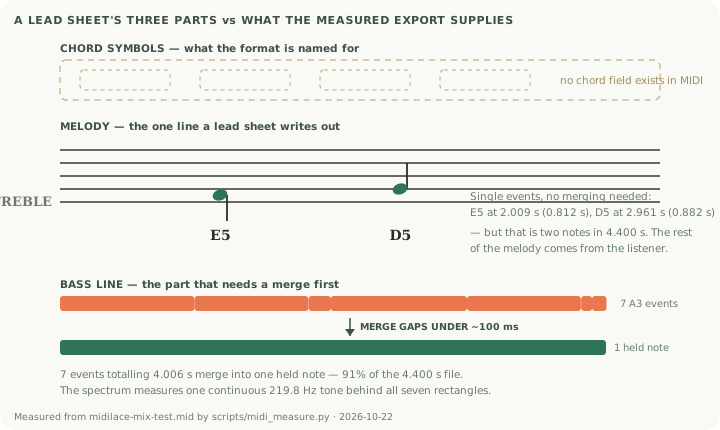
| Component | What the lead sheet shows | What the export supplies | Verdict |
|---|---|---|---|
| Melody | One staff, the top line | Top two lanes: one event on E5 at 2.009 s, one on D5 at 2.961 s | Nearly there — single events, no merging needed |
| Chord symbols | A symbol above each bar | No chord field exists in MIDI | Absent — supplied by the player's ears |
| Bass line | Bass staff or slash notation | Low lane: 7 A3 events totalling 4.006 s for one continuous 219.8 Hz tone | Needs merging before it reads as a line |
The hum pair is the extreme case of the melody-only idea: one continuous 4.40-second tone arrives as 32 events across 4 pitches, each lasting 0.059 to 0.188 seconds. A lead sheet's melody staff would carry one held note. The gap between those two readings is the whole difference between an export and a chart.
Why the chord symbols cannot come from the file
MIDI has no field for harmony. Every event is a pitch, an onset and a duration — that is the entire vocabulary. A tool can propose chord symbols by pattern-matching the note groups (C–E–G looks like C major), and the proposal can be checked: play the bar, hear the chord, see if the symbol matches. But the proposal is an inference on top of the data, not a reading of it, and on this site's measured exports the note groups are unreliable enough — 13 events where a held tone arrived as 7 — that the inference inherits every error in the export.
The bass line needs one measured correction. The low lane's seven events start at 0.000, 0.986, 1.823, 1.986, 2.985, 3.821 and 3.902 s, with gaps of 0.986, 0.837, 0.163, 0.999, 0.836 and 0.081 s. Merging same-pitch events separated by less than about 100 ms turns the lane into one held note spanning 91% of the file. That is the bass line a lead sheet would sketch — after the merge, not before.
And the melody lane's limitation is honesty, not accuracy. E5 and D5 are single, clean events — but they are two notes in 4.40 seconds. A lead sheet of a real song has a melody that lasts the song; the export's top lane stops where its events stop, and the missing phrases are supplied by the listener or the recording, exactly like the symbols.
Building a lead sheet from a recording
- Take the melody from the top lane, phrase by phrase. Convert 10 to 20 second windows; the top lane of each window is the melody candidate, checked by ear against the recording.
- Merge the bass lane, then decide how much of it the chart needs. Many lead sheets carry only the roots or slash notation. On the measured file, the merged low lane is one held note — more than a lead sheet usually wants.
- Write the chord symbols yourself, one bar at a time, listening. This is the slow part and the part that makes it a lead sheet. Anything a tool proposed is a draft to correct here.
- Label the chart honestly. Mark what was read from the recording and what was inferred. The downloadable files on this site exist so a player can check any bar against the source.
- Leave the arrangement to the players. That is the deal the format makes: the chart states the tune; the band states the style. A lead sheet that tries to also be the arrangement is a different document — see the piano solo / piano-vocal comparison.
Questions about lead sheets
What exactly is on a lead sheet?
One melody staff, chord symbols above it, and usually lyrics if the tune has them. Some add a bass line or slash notation. Everything a comping player needs to state the tune, and nothing an arranger would argue with.
How is it different from full sheet music?
Full sheet music — a piano solo chart, a band arrangement — writes out every part. The lead sheet writes one line and trusts the players. Which one you want depends on whether you are stating a tune or documenting an arrangement.
Can a converter produce a lead sheet?
It can produce the melody lane, which is a real head start — the measured top lanes were single events on E5 and D5, no merging needed. Chord symbols are not in any MIDI export, so they are written by a listener either way.
Do I need the bass line on it?
Optional, and often skipped in favour of slash notation or roots. If you include it, merge the low lane first — on the measured file that is seven chopped events becoming one held note.
Can I try it on my own track?
Yes. The converter on the home page runs in your browser with no account, processes the recording on your device, and exports a standard MIDI file you can read the top lane from.