MP3 to guitar chords: the notes are in the audio, the chord name is not.
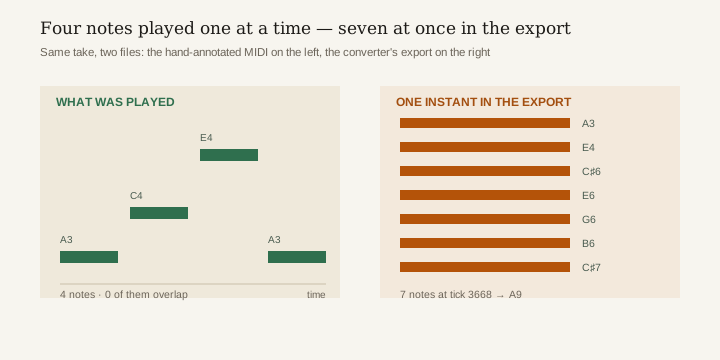
A conversion recovers notes and their timing. A chord name is a decision made on top of them, and it can only be observed where several notes sound together. In the site's four-note A minor take, 0 of the 4 notes sound with any other note. The export of that same take holds 7 notes at one instant, and those seven have exactly one name in a 288-symbol vocabulary: A9 — a chord containing C sharp, in a take that has no C sharp.
1 name — Amin. Add the bass, or more notes, and the count changes.
A root, a quality — and neither is in the file
A chord name has two parts: a root and a quality. The quality is a set of intervals measured from that root, so a major triad is the root, four semitones above it and seven, and a minor triad is the root, three and seven. Everything else a player says about the chord — which string, which inversion, which capo — hangs off those two facts.
The audio carries frequencies. What comes out of a conversion is a list of note events: a pitch, a start time, a length, a velocity. A MIDI file has no chord field, and no standard meta event that names a chord, so the name is not something the conversion dropped on the way out: it was never in the format. MusicXML does have a place for it — a <harmony> element holds a chord symbol — but that element is written by a person or a model, not detected from the recording.
That leaves two ways a name can be justified, and they are not equally strong. Observed: several notes sound at the same time, and the set of pitch classes they form matches a symbol. Inferred: the notes are played one after another, and the name is a claim about which of them belong together — a decision over a window of time, which the recording does not make for you.
Nine files, and how many notes ever sound together
Every file the site keeps as a test take was read with one rule: two notes are simultaneous when their sounding intervals overlap by at least one tick. The table gives, per file, how many notes have at least one partner, and the widest instant — the largest number of notes sounding at one moment — together with what that set is called in the 288-symbol vocabulary described further down.
| Take | Note events | With a partner | Widest instant | Sounding there | Exact name |
|---|---|---|---|---|---|
| 12-second guitar take, hand-annotated | 45 | 41 | 4 notes | A♯3 D4 F4 A♯4 | A♯maj |
| same take, exported from the WAV | 68 | 62 | 5 notes | A♯3 D4 F4 A♯4 A♯5 | A♯maj |
| A minor arpeggio, ringing, hand-annotated | 4 | 0 | 1 note | A3 | — |
| same take, exported (ringing) | 29 | 29 | 7 notes | A3 E4 C♯6 E6 G6 B6 C♯7 | A9 |
| A minor arpeggio, muted, hand-annotated | 4 | 0 | 1 note | A3 | — |
| same take, exported (muted) | 23 | 23 | 6 notes | A3 A4 C♯6 E6 G6 C♯7 | A7 |
| hummed four-note test | 8 | 0 | 1 note | A3 | — |
| three-note test (A4 C5 E5) | 4 | 0 | 1 note | A4 | — |
| four-note piano-like test | 4 | 3 | 2 notes | E4 G4 | — |
The whole table is downloadable, so the counts can be checked against the MIDI files rather than taken on trust: chord-simultaneity.csv. The script behind it, scripts/chord_read.py, reads the exported MIDI directly and recomputes every column.
Two of those rows show what the difference means. In the 12-second take the widest instant is four notes — A♯3, D4, F4 and A♯4 — which is a B flat major triad with the root doubled, and it has exactly one name in the vocabulary. The export widens it to five by adding the octave above, and the name does not change, because an octave adds no new pitch class. The chord survived conversion because it was there.
The A minor take is the other case. Its four notes — A3, C4, E4, A3 — never overlap: each one starts after the previous one has stopped, so the widest instant is a single note and there is no chord to observe. The export of that same file holds seven notes at tick 3668, and the set includes C♯6 and C♯7. The take has no C sharp anywhere in it. Those seven pitch classes match exactly one symbol in the vocabulary — A9 — which is a dominant chord with a major third. That chord was not found; it was made, out of notes the transcription invented and then grouped.
Four pitch classes, one to four names — and sometimes none
The vocabulary used here is deliberately mechanical, so the counts can be recomputed: 12 roots × 24 qualities = 288 symbols, and a symbol matches only when its pitch-class set is exactly equal to the set you gave it. No missing tones, no extra tones, no "close enough". The qualities are listed in the download, so a reader can add one and watch the counts move.
| Notes | Pitch classes | Exact names | Count |
|---|---|---|---|
| C E G | 0 4 7 | Cmaj | 1 |
| A C E | 0 4 9 | Amin | 1 |
| A C E G | 0 4 7 9 | C6 · Am7 | 2 |
| D F A C | 0 2 5 9 | Dm7 · F6 | 2 |
| C D♯ F♯ A | 0 3 6 9 | Cdim7 · D♯dim7 · F♯dim7 · Adim7 | 4 |
| A C D E | 0 2 4 9 | none | 0 |
| C D E G | 0 2 4 7 | Cadd9 | 1 |
The count is not a function of how many notes you have. Four pitch classes can have one name, two names, four names or none. A C E G is C6 or Am7 depending on which note is in the bass: with A underneath it is Am7/A, with C underneath it is C6/C, and the two are the same four notes. The diminished seventh is the extreme case — the same four pitch classes answer to four different roots, because the chord repeats every three semitones — so a name for it can only be chosen, never read off.
The zero is worth keeping in the table rather than hiding. A C D E has no exact name in these 288 symbols because the vocabulary has no add4 quality; add one and the same set is Amadd4. So the count is a property of the vocabulary as much as of the chord, which is exactly why two tools can disagree about the same four notes without either of them mishearing anything.
The second download is that table: chord-name-counts.csv.
Five checks, in this order
Each check only looks at what the previous one left standing. Counting simultaneity first saves the other four: a take with nothing simultaneous has no chord names to correct, only names to argue about.
- Count the notes that sound together. If the widest instant in the file is one note, you are looking at a melody, and every chord name attached to it is an inference over a window rather than an observation. Decide whether you accept that before you start fixing names.
- Compare the widest instant against what you can hear. An export that holds more notes at once than the recording does is naming its own errors — the A9 above came from seven notes at one instant in a take where nothing overlapped.
- Fix the bass before you fix the name. A C E G is two different chords until you say which note is underneath; so is every minor seventh, because it is also a sixth. The bass is a fact about the arrangement, and no converter can supply it.
- Start from a take that has chords in it. A strummed or fingerpicked accompaniment gives simultaneity to read. A single-line solo gives you a melody, and the chord chart is then a harmonisation you are writing, not a transcription you are correcting.
- Export the name, not only the notes. A MIDI export drops the chord symbol again; MusicXML keeps it in
<harmony>, and a chord chart keeps it in the open. If the name only exists in a screenshot, the next person redoes the work.
None of this makes conversion useless for chords. It splits the job at the point where the two halves are checkable: the notes come from the audio, the name comes from a rule you can state — and a rule you can state is a rule you can argue with.
Questions about MP3 to guitar chords
Can an MP3 be converted to guitar chords directly?
The audio can be converted to notes, and chords can then be named from those notes. The naming step is separate because the audio does not contain it: a MIDI file has no chord field, and a chord symbol is written into MusicXML by hand or by a model. One step gives you pitches; the second gives you names.
Why does the converter name a different chord than the one I hear?
Usually because the notes it named are not the notes that were played. In the A minor take on this page the export holds seven notes at one instant where the recording never has more than one sounding, and two of those seven are C sharps that the take does not contain. Correcting the notes usually corrects the name with them.
Can you get chords from a guitar solo?
Not by observation. A solo is one note at a time, so there is nothing simultaneous to read; any chord chart for it is an inference over a window, which is a harmonisation rather than a transcription. The same applies to a hummed melody: the site's four-note hum has no overlapping notes at all.
Why do some chords have more than one name?
Because a name carries a root as well as a set of notes, and the notes alone do not always fix the root. A C E G is C6 with C in the bass and Am7 with A in the bass. A diminished seventh has four names because the same four pitch classes repeat every three semitones. The name is chosen by the bass and the key.
How many chords can four notes have?
In the 288-symbol vocabulary on this page, between zero and four. C D E G has one name, A C E G has two, C D♯ F♯ A has four, and A C D E has none until an add4 quality is added. The count depends on the vocabulary as much as on the notes.
What is the difference between a chord name and a chord voicing?
The name is the root and the quality; the voicing is where those notes sit on the instrument. A name can be played in many places, and choosing one of them is the tab problem, not the naming problem — that is what the MP3 to guitar tab page measures.
Do I need the key to name a chord?
For a single unambiguous chord, no. For the ambiguous ones, yes: C6 and Am7 are the same notes, and which one a chart should print depends on where the progression is going. That is why a chord chart made from audio without a key sounds plausible and still disagrees with the sheet music.