Piano roll vs sheet music: the data, and the reading of it.
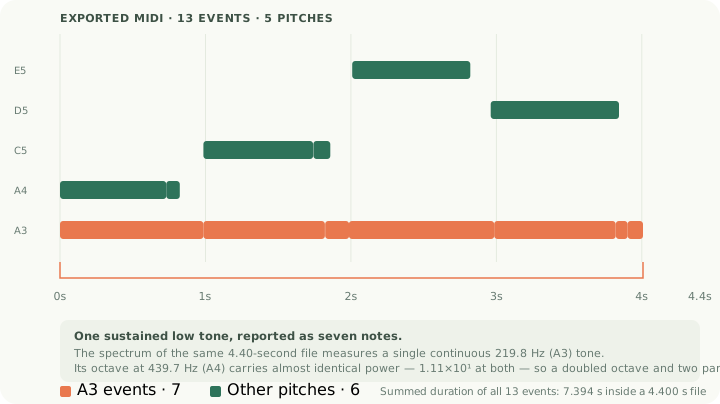
The roll is the export's native shape; sheet music is an interpretation drawn on top of it. Measured on this site's 4.40-second test file, the roll holds thirteen events with 7.394 seconds of note time — overlap included, exactly as measured. The sheet forces those events into a meter, and at 120 BPM the export's eleven onsets collapse onto seven positions, with three grid points holding collisions. Both readings are honest; they answer different questions, and the measured file shows what each one costs.
Convert a clip and try both readingsThe same export, read both ways
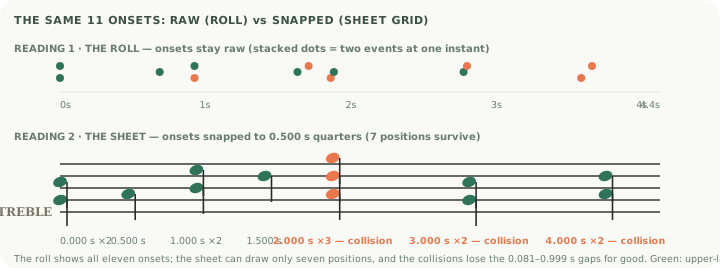
The source is the site's own 4.40-second multi-tone mix with its exported MIDI (thirteen events, five pitches, eleven distinct onsets). The figure below shows the two readings of those onsets: raw in the roll, snapped in the sheet.
| Question | Piano roll | Sheet music |
|---|---|---|
| How many notes? | 13 rectangles, exactly as exported | A decision — the seven low-lane onsets need merging or interpreting first |
| How many onsets? | 11 distinct onsets, irregularly spaced | 7 grid positions at 120 BPM; 2.000 s holds 3 onsets, 3.000 s and 4.000 s hold 2 each |
| How much note time? | 7.394 s, overlapping freely in a 4.40 s recording | Overlap has to be resolved into voices or staves before it can be drawn |
| Where are the pitches? | Five lanes: A3, A4, C5, D5, E5, low to high | Staff positions: A3 top line of the bass staff; A4, C5, D5, E5 on the treble staff |
| What is added? | Nothing — it is the measured data | Stems, beams, bar lines, meter — all decisions, none of them in the file |
The pitch-position row is checkable in seconds: the five exported pitches map onto exactly five memorable staff positions, which is why a player can start reading the sheet before a single rhythm question is settled.
The same trade on a real take
The mix is synthetic. On the site's 12-second solo guitar take the same operation runs at full size: the export's 51 onsets resolve onto 25 positions of a 0.500-second grid, with sixteen grid points holding colliding onsets and corrections up to 0.238 s. The annotated ground truth — the human answer key — resolves its 44 onsets onto 24 positions, with corrections up to 0.240 s.
That last number is the honest version of the comparison: a hand-annotated performance is not on a 0.5-second grid either. The sheet reading of a real recording is an interpretation of an interpretation — the detector estimated the onsets, and the meter re-reads them. Neither reading is "the music"; the recording is, and both files are downloadable above so a player can check.
What the roll keeps, and what the sheet throws away
The roll keeps what was measured. Durations survive exactly: the low lane's seven events total 4.006 seconds against one continuous 219.8 Hz tone, and that discrepancy stays visible instead of being resolved. Overlap survives: 11 of the 13 events sound while another event sounds, and the roll can show that because two rectangles can occupy the same moment — in the recording, they did.
The sheet pays for readability with decisions. At 120 BPM, 1.823, 1.986 and 2.009 s all snap to the same quarter — as do 3.821 and 3.902 s. Three onsets become one position and two more become one, and the sheet can no longer show that they were ever apart. The gaps were 0.163 s and 0.081 s: small, but on this synthetic file they were split artefacts, and the merge was right. On your recording, the same collision could be two played notes.
Neither form fixes the export's errors. The roll shows the seven chopped events honestly; the sheet renders them honestly; both are wrong about the music until someone merges them. The reading format is downstream of the correction, which is why editing starts in the roll — see what a piano roll is — and finishes on the stand.
Which reading to use when
- Correcting a transcription: the roll, always. Merging the chopped low lane, deleting octave artefacts, checking overlaps — all of it is visual work on rectangles, and all of it should happen before any engraving.
- Handing a chart to a reader: the sheet. Players read staves, and the measured export's five pitches convert cleanly to positions — the sheet is where a musician can see a part, not a dataset.
- Checking a tool's claim: the roll. A page that says "we transcribed your song" is checkable in one look at the roll: count rectangles per lane, compare against the recording. The measured file's roll shows seven events where the spectrum shows one tone.
- Keeping the evidence: both. The roll is the raw export; the sheet is the interpretation. Keeping both, and labelling which is which, is what lets another musician trust the chart.
Questions about the two formats
Which is more accurate?
The roll is more faithful — it is the measured data with nothing resolved. The sheet is more useful to a reader but has made decisions: at 120 BPM the export's eleven onsets became seven positions. Faithful and readable are different goals, and the measured file shows the trade exactly.
Can sheet music show overlapping notes?
Yes, with separate voices on a staff or split staves — an engraving decision, not something the export flags. On the measured file, 7.394 seconds of note time inside a 4.40-second recording means the overlap is real and somebody has to decide how to draw it.
Is a piano roll easier to learn?
For producers, usually yes — it is the DAW's native view and it maps onto the file exactly. For gigging musicians, the staff is the shared language. The export serves both; the conversion between them is where the interpretation happens.
What happened to the gaps when the events shared a grid point?
They disappear into the merge. The 0.163 s and 0.081 s gaps between those onsets carry no note value on a 0.5 s grid, so the sheet cannot show them. That is the cost of the sheet reading, stated plainly.
Can I try it on my own track?
Yes. The converter on the home page runs in your browser with no account, processes the recording on your device, and exports a standard MIDI file that opens in both a DAW's roll view and any notation program.