Reading sheet music is two jobs: pitch position, then rhythm.
If you have a MIDI export, the pitch half is already done for you. The site's measured export of a 4.40-second test file names its five pitches directly — A3, A4, C5, D5, E5 — and each maps to exactly one staff position, drawn in the figure below. The rhythm half is not in the file as notation: the export carries durations in seconds (one event of 0.812 s, another of 0.882 s), and turning seconds into note values is the reading decision. This page walks both halves, starting from the export.
Convert a clip and read its pitchesThe five measured pitches, and where they sit
The export of the site's own /examples/midilace-mix-test.wav contains five distinct pitches. The figure places each one on a staff; the table gives the lookup. Everything in it is produced from the file — the MIDI numbers are in the export, the staff positions follow from the numbers.
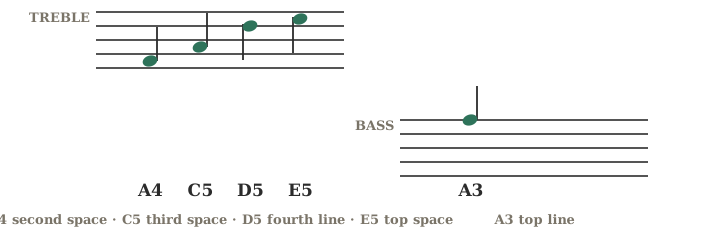
| Pitch | Staff position | Why it is memorable |
|---|---|---|
| A3 (57) | Top line of the bass staff | The top line is the anchor every bass reader memorises first |
| A4 (69) | Second space of the treble staff | The "A" of the treble spaces, F–A–C–E |
| C5 (72) | Third space of the treble staff | Middle C sits one ledger line below the treble staff; C5 is an octave above it |
| D5 (74) | Fourth line of the treble staff | Fourth line up, between C5 and E5 |
| E5 (76) | Top space of the treble staff | Highest note of this export — top space, not the top line |
Two clefs carry these five notes: the bass staff for A3, the treble for the rest. That split is normal — a bass note an octave below the treble's bottom line is what the bass staff exists for.
How the position lookup works
The staff is a map of the alphabet: lines and spaces step A, B, C, D, E, F, G upward, and wrap to the next octave after G. Treble lines from the bottom are E4, G4, B4, D5, F5; treble spaces are F4, A4, C5, E5. So A4 is the second space, C5 the third, D5 the fourth line, E5 the top space — the four positions the figure above draws. Bass lines from the bottom are G2, B2, D3, F3, A3, which puts A3 on the top line.
The export does this lookup for you in the other direction: it names pitches, and the names are the answer to "where on the staff". A converter that reports "C5" has already done the note-identification half of reading. What it cannot do is draw the staff — that is the engraving layer, covered in what music engraving is.
One caution from the measured file: an octave pair is easy to misplace. The export contains A3 and A4 together — one 219.8 Hz tone and its 439.7 Hz octave at near-identical measured power. On a staff, A3 sits on the bass staff's top line and A4 on the treble's second space; confusing them moves a note by an octave, the most common early reading error.
The wide-range version of the same exercise is the site's 12-second guitar take: its export names 19 distinct pitches from G#2 to C7, and its annotated answer key names 15 from A#2 to C5. Reading those means counting ledger lines above the treble staff and below the bass — and noticing, as the measured files show, that the export's top octave (up to C7 against an annotated ceiling of C5) is where artefacts live, not where the music is.
Where the rhythm reading begins
- Take the durations from the export, in seconds. The measured export's top-lane events last 0.812 s (E5) and 0.882 s (D5); the low lane's events run 0.081 s to 0.999 s.
- Set a tempo reading and compute the grid. The file has no tempo event, so the standard default of 120 BPM applies: a quarter note is 0.500 s, an eighth 0.250 s, a half 1.000 s.
- Match each duration to a note value — and expect to decide, not to look up. The table below is the measured file's own durations against the values a 120 BPM reading gives them. 0.812 s is longer than a quarter and shorter than a half, so a reader writes a dotted quarter, or a quarter tied to an eighth. Measured durations rarely land on exact values; that matching is the interpretation.
- Solve the onsets before the values. The seven A3 onsets are irregular: 0.000, 0.986, 1.823, 1.986, 2.985, 3.821, 3.902 s, with gaps of 0.081 to 0.999 s. Until the chopped lane is merged — seven events into one held note covering 91% of the file — the rhythm question has no stable answer.
- Practise on the roll first if the staff is new. The same export drawn as rectangles shows pitch and duration at a glance; the staff adds the alphabet map from the table above.
- Check every note against the recording. The site's annotated guitar case uses an 80 ms match window with mean timing error of 15 to 17 ms on found notes — a fair tolerance for "same note", and a reminder that the durations are estimates.
| Measured duration | Event | Closest value at 120 BPM | The reader's decision |
|---|---|---|---|
| 0.812 s | E5, the top-lane event | Dotted quarter (0.750 s) or quarter tied to eighth | Either spelling reads the same; pick the one that shows the beat |
| 0.882 s | D5, the second melody event | Dotted quarter (0.750 s) or half (1.000 s) | Between the two: 0.132 s over a dotted quarter, 0.118 s under a half — the reader picks by what the next phrase needs |
| 0.081 s | shortest event in the export (A3 lane) | 32nd note (0.063 s) | Shorter than any playable value — almost certainly a split artefact, not a note |
| 0.999 s | longest single event (A3 lane) | Half note (1.000 s) | Within 1 ms of a half — the one clean match in the file |
Questions about reading sheet music
Do I have to read rhythm to use sheet music?
To play from it, yes — pitch position tells you which notes, rhythm tells you when. The good news from the measured export: the pitch names come out of the converter directly, so the alphabet map above is the only memorisation the first half needs.
Where is middle C?
One ledger line below the treble staff, one above the bass staff. In the measured table, C5 is the C one octave above that — the third space of the treble staff.
Is the top space different from the top line?
Yes, by one step — and on this export it matters: E5 (the top space) is the highest measured pitch, while the top line is F5. Reading position one step off is the classic octave-scale error.
Can I learn from a piano roll instead?
Many players do. The roll is the export's native view and needs no alphabet; the staff is the shared notation language. The same file reads as both — see piano roll vs sheet music.
Can I try it on my own track?
Yes. The converter on the home page runs in your browser with no account, processes the recording on your device, and exports a standard MIDI file whose pitches you can place on a staff with the table above.